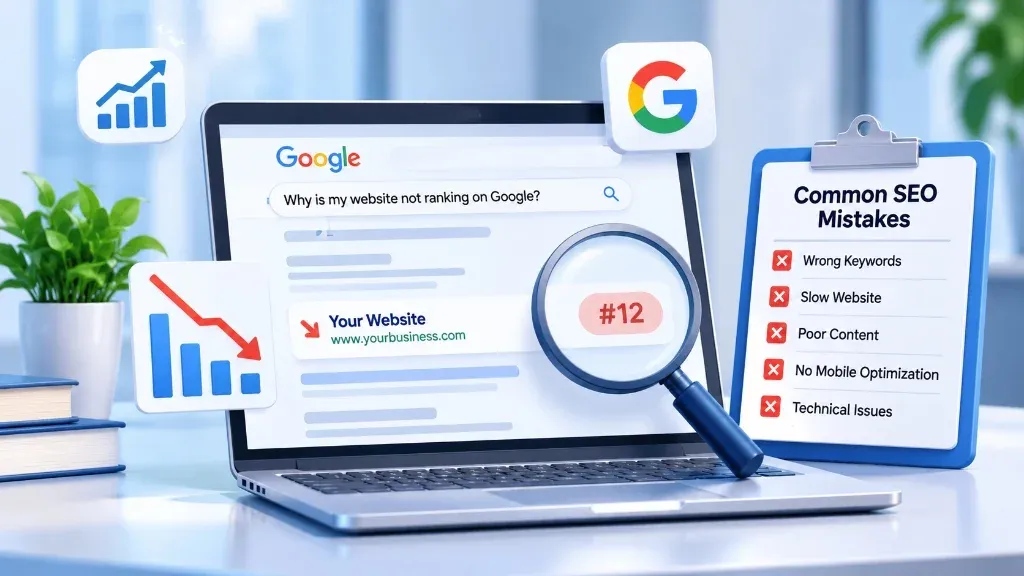
Your website may look attractive, offer excellent services, and contain useful information, but what happens if potential customers cannot find it on Google?
Having a website is only the first step towards building an online presence. To reach the right audience, your website needs to be visible in search engine results. This is where Search Engine Optimization (SEO) plays an important role.
Many businesses invest in website development but overlook important SEO practices. As a result, their websites struggle to appear in search results, receive limited organic traffic, and miss valuable business opportunities.
Whether you run a small business, an online store, or an established company, understanding the reasons behind poor Google rankings can help you improve your website's visibility.
Let's explore 10 common SEO mistakes that could be preventing your website from ranking on Google.
1. Targeting the Wrong Keywords
Keywords are the words and phrases people enter into search engines when looking for information, products, or services.
One common SEO mistake is targeting keywords that are either too competitive or unrelated to what potential customers are searching for.
For example, a local website development company targeting only the keyword "technology" may struggle to reach its intended audience. A more specific keyword such as "website development services for small businesses" can attract visitors with a clearer interest.
Businesses should research relevant keywords before creating website content. Focus on search intent, keyword relevance, and phrases that match the services you provide.
Choosing the right keywords helps search engines understand your content and connect it with relevant searches.
2. Ignoring On-Page SEO Optimization
Creating website content is not enough if individual pages are not properly optimized.
On-page SEO involves improving different elements of a webpage to help search engines understand its purpose and make it easier for visitors to navigate.
Some important elements include:
- •Page Titles: Every page should have a clear and descriptive title that explains its content.
- •Meta Descriptions: Short summaries that help users understand what a page offers in search results.
- •Heading Tags: Proper use of H1, H2, and H3 headings to organize information.
- •Image Alt Text: Descriptive text that helps search engines understand website images.
- •URL Structure: Simple and meaningful URLs that describe the page content.
For example, instead of using a page title such as "Our Services", a business could use "Professional Website Development Services".
Proper on-page SEO makes website content easier to understand for both search engines and visitors.
3. Publishing Low-Quality or Duplicate Content
Content plays an important role in helping websites attract visitors and establish credibility.
However, publishing content simply to include keywords can negatively affect the overall quality of a website.
Some businesses make the mistake of copying content from competitors, publishing short articles without useful information, or creating multiple pages with nearly identical content.
For example, an article titled "Best Website Development Services" should provide meaningful information about website development, important features, business benefits, and how to choose the right service provider.
Instead of focusing only on search engines, create original and informative content that answers users' questions.
Regularly review existing pages, update outdated information, and make sure every article provides something useful to readers.
4. Having a Slow-Loading Website
Website speed is an important part of the overall user experience.
Imagine a customer visiting your website to explore your services, but the page takes several seconds to load. They may leave before even seeing what your business offers.
Common reasons for slow website performance include:
- •Large and unoptimized images.
- •Excessive plugins and unnecessary scripts.
- •Poor-quality hosting services.
- •Unoptimized website code.
- •Too many external resources.
Businesses can improve website performance by compressing images, reducing unnecessary scripts, using reliable hosting, and optimizing website resources.
Tools such as Google PageSpeed Insights can help identify performance problems and provide recommendations for improvement.
A faster website makes it easier for visitors to explore your content and interact with your business.
5. Not Optimizing Your Website for Mobile Devices
A website that works perfectly on a desktop computer may not provide the same experience on a smartphone.
Today, many people use mobile devices to search for businesses, compare services, read articles, and make purchases.
If your website is difficult to navigate on smaller screens, visitors may leave without exploring your services.
A mobile-friendly website should include:
- •Responsive layouts that adjust to different screen sizes.
- •Readable text without unnecessary zooming.
- •Easy-to-use navigation menus.
- •Properly sized images and buttons.
- •Fast-loading mobile pages.
Google primarily uses the mobile version of a website's content for indexing and ranking.
Therefore, businesses should ensure that their websites provide a consistent and convenient experience across smartphones, tablets, and desktop devices.
6. Ignoring Technical SEO Issues
Technical SEO focuses on improving the technical structure of a website so that search engines can discover, crawl, and understand its pages.
Even if your website contains useful information, technical problems can prevent important pages from appearing in Google search results.
Some common technical SEO issues include:
- •Broken links that lead to unavailable pages.
- •Incorrect robots.txt settings.
- •Accidental noindex tags that prevent pages from being indexed.
- •Missing or incorrectly configured XML sitemaps.
- •Duplicate URLs without proper canonicalization.
- •Website security and accessibility problems.
For example, if an important service page accidentally contains a noindex instruction, Google may exclude that page from its search results.
Businesses should regularly perform technical SEO audits to identify and resolve these issues.
Google Search Console is a useful tool for monitoring indexing status, identifying website errors, and understanding how Google interacts with your pages.
7. Neglecting Internal Linking and Backlinks
Links help search engines discover website pages and understand how different pieces of content are connected.
There are two important types of links that businesses should consider.
Internal Links
These links connect different pages within the same website.
For example, a blog discussing website development can link to the company's website development service page. This helps visitors discover related information and allows search engines to find other important pages.
Backlinks
These are links from other websites that point towards your website.
For example, a business may receive a backlink when an industry publication, business directory, or relevant website mentions its services.
However, not all backlinks are valuable. Buying links or participating in manipulative link-building schemes can violate Google's spam policies.
Focus on creating useful content, building genuine industry relationships, and earning relevant links from trustworthy websites.
8. Missing Local SEO Opportunities
For businesses that serve customers in specific locations, local SEO is an important part of improving online visibility.
Many customers search for services using location-based phrases such as:
- •Website development company in Mumbai.
- •SEO services near me.
- •Best web development agency in Bandra.
If your business does not provide clear location information or maintain an updated Google Business Profile, you may miss opportunities to connect with nearby customers.
Businesses can improve local SEO by:
- •Creating and maintaining an accurate Google Business Profile.
- •Including relevant location information on their website.
- •Keeping business contact details consistent.
- •Encouraging genuine customer reviews.
- •Creating useful location-specific service content.
Local SEO helps businesses become more discoverable among people searching for relevant services in their area.
9. Not Updating Website Content Regularly
Publishing a website and leaving it unchanged for years can limit opportunities to keep information useful and relevant.
Business services change, industry trends develop, and customer expectations evolve. Outdated information can create confusion and reduce visitors' confidence in your business.
For example, a website that still displays discontinued services, incorrect contact information, or outdated pricing may create a poor impression.
Businesses should regularly review their website content and:
- •Update outdated service information.
- •Improve older blog articles.
- •Replace broken links.
- •Add relevant information and examples.
- •Remove or improve content that no longer serves visitors.
Regular updates help maintain a useful website, although simply publishing new content frequently does not guarantee higher Google rankings.
10. Not Tracking SEO Performance
One of the biggest SEO mistakes is making changes without measuring whether they are actually working.
Without tracking website performance, businesses may not understand which pages attract visitors, which keywords generate impressions, or where potential customers leave the website.
Some important SEO performance indicators include:
- •Organic Traffic: Visitors arriving through unpaid search results.
- •Keyword Rankings: The positions at which your pages appear for relevant searches.
- •Click-Through Rate (CTR): The percentage of search impressions that result in clicks.
- •Impressions: How frequently your website appears in search results.
- •Conversions: Visitors who complete valuable actions, such as submitting an enquiry or making a purchase.
Tools such as Google Analytics and Google Search Console can help businesses monitor website performance and identify areas that need improvement.
SEO should be treated as an ongoing process. Regular analysis allows businesses to make informed decisions and improve their digital strategy over time.
How Can Professional SEO Services Help Improve Your Website Rankings?
Improving website rankings requires more than adding keywords to a few pages. It involves understanding your website's current performance, identifying technical problems, researching relevant keywords, and creating a strategy that supports your business goals.
Professional SEO services can help businesses with:
- •SEO Audits: Identifying technical and content-related problems.
- •Keyword Research: Finding relevant search terms used by potential customers.
- •On-Page SEO: Improving page titles, headings, descriptions, and content.
- •Technical SEO: Addressing crawling, indexing, and website performance issues.
- •Content Optimization: Creating useful and relevant website content.
- •Local SEO: Improving visibility for location-based searches.
- •Performance Monitoring: Tracking results and identifying opportunities for improvement.
At Giga Nexus Technology, businesses can explore SEO solutions designed to improve their online presence, strengthen search visibility, and reach relevant audiences.
Final Thoughts
A website that does not rank on Google may be missing valuable opportunities to reach potential customers. From incorrect keyword targeting and poor-quality content to technical SEO problems and slow website performance, several factors can affect your online visibility.
The key is to understand that SEO is not a one-time activity. It requires regular improvements, useful content, technical maintenance, and continuous performance monitoring.
Whether you are running a startup, managing an established business, or planning to launch a new website, investing in the right SEO strategy can help strengthen your digital presence.
At Giga Nexus Technology, businesses can explore professional SEO solutions to improve website visibility, connect with their target audience, and build a stronger online presence.
Ready to improve your website's visibility on Google? Get in touch with Giga Nexus Technology and take the next step towards building a stronger digital presence.
Related Topics
- •Website Development and Business Growth
- •On-Page SEO vs Off-Page SEO
- •Local SEO Strategies for Small Businesses
- •Technical SEO: A Complete Beginner's Guide
- •How to Choose the Right SEO Company for Your Business
- •Website Speed Optimization and Its Importance